
November 20, 2026
Med Spa SEO: How Aesthetic Clinics Attract High-Value Clients Online
A med spa client is rarely a one-off. Someone who books Botox today will probably be back in three or four months, and again after that. They might add filler, a skin treatment, or a laser package along the way. Win one client through search, and you may keep them for years.
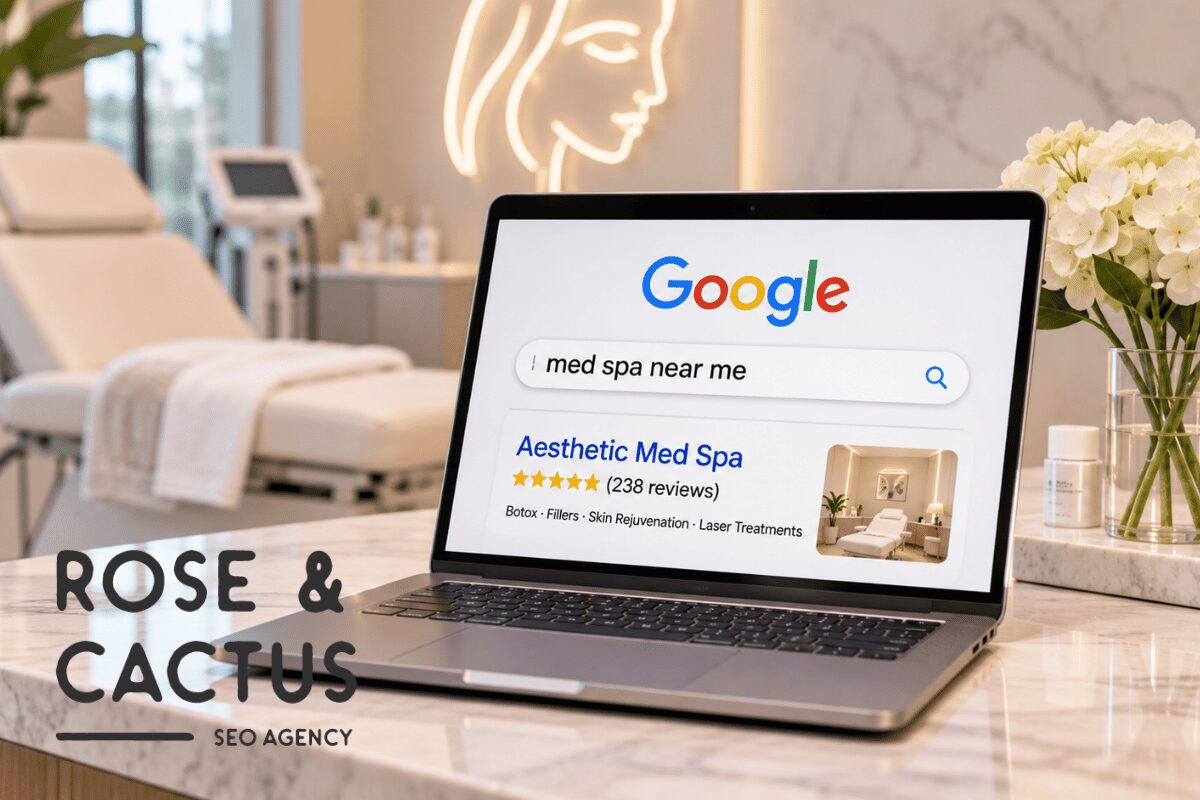
That’s what makes SEO for a med spa so worthwhile. The medical aesthetics industry in the US now brings in more than $17 billion a year, according to the American Med Spa Association, and competition for local clients is fierce. Most of those clients start with a search like “lip filler near me” or “best Botox in Austin,” then compare reviews, photos, and prices before booking.
This guide covers how med spas can win those searches: your Google Business Profile, treatment pages, provider bios, before-and-after galleries, and the rules that apply to all of it.
Why med spa SEO is different
Google holds health content to a higher standard. Injectables, lasers, and medical-grade skin treatments are health topics, and Google treats them as “Your Money or Your Life” content. Its guidance on helpful, reliable content says that for these topics, “our systems give even more weight to content that aligns with strong E-E-A-T,” meaning experience, expertise, authoritativeness, and trust. Who’s behind your content matters as much as what it says.
Clients judge with their eyes. Aesthetic decisions are visual. Real before-and-after photos, real photos of your clinic, and real faces of your providers do more persuading than any amount of copy.
You’re competing with more than other med spas. Dermatology practices, plastic surgeons, salons offering “aesthetic” services, and national chains all compete for the same searches.
Repeat value changes the math. A client who comes back four times a year for injectables is worth far more than their first appointment. That’s why it pays to prioritize treatments with repeat potential in your SEO.
There are rules. Patient photos fall under HIPAA, and reviews and testimonials fall under FTC rules. Getting these wrong is a bigger risk than ranking poorly.
Start with your Google Business Profile
Most local med spa clients find you through Google’s map results, and your Google Business Profile decides whether you appear.
Use your real business name. “Lumen Aesthetics” is right. “Lumen Aesthetics | Botox & Filler Austin” breaks Google’s guidelines and risks suspension.
Choose your categories carefully. “Medical spa” is usually the right primary category. Add secondary categories only for services you really offer, such as skin care or laser hair removal.
List every treatment with detail. Add each service with a short description, and prices or starting prices where you can. Clients searching for a specific treatment are more likely to choose a profile that clearly offers it.
Add a booking link. Many clients would rather book online than call, especially outside business hours.
Show real photos. Your treatment rooms, reception area, building entrance, and team. Polished stock photos of models make every med spa look the same.
Consider provider profiles. Google allows individual profiles for public-facing medical practitioners, separate from the business profile. For a medical director or a well-known injector, this can help. For most smaller med spas, focusing reviews on one strong business profile works better.
Build reviews the right way
Reviews matter enormously for med spas, because clients are trusting someone with their face. But this is also where med spas most often run into trouble.
Ask at the right moment. For injectables, the best time is often the follow-up, a couple of weeks after treatment when results have settled. For skin and laser treatments, ask after the client sees visible improvement.
Ask everyone, not just happy clients. Google’s review policies don’t allow businesses to selectively ask only satisfied customers for reviews (sometimes called review gating).
Follow the FTC rules. The FTC’s 2024 rule on reviews and testimonials bans fake reviews, incentives tied to leaving a positive (or negative) review, undisclosed reviews from staff, and threats or intimidation to remove negative reviews. A discount in exchange for a five-star review is off the table.
Respond carefully. Thank clients for positive reviews without confirming they’re a patient or mentioning their treatment. Handle complaints offline. Under HIPAA, confirming someone is your patient in a public reply can be a privacy breach, even if they mentioned it first.
Treatment pages that turn searches into bookings
Every treatment you want to be found for needs its own page. A single “Services” page listing everything won’t rank for anything.
A strong treatment page answers what a prospective client actually wants to know:
- What the treatment does and which concerns it addresses
- Who it’s suitable for, and who it isn’t
- What happens during the appointment
- Downtime, side effects, and aftercare
- How long results take to appear and how long they last
- Price or a starting price
- Who performs it, with a link to their bio
- Real before-and-after photos
- Common questions, answered clearly
Use the words clients search for. People search “Botox” far more than “neuromodulator,” and “lip filler” more than “lip augmentation.” You can explain the clinical terms on the page, but the main headings should match how real people search.
Make sure the medical information is accurate and reviewed by a qualified provider. Google says health content “must be highly accurate and consistent with established expert consensus,” and inaccurate or exaggerated claims also put you at risk with regulators.
Provider bios and your medical director
For health content, who’s behind the advice matters. Provider bios are some of the clearest trust signals a med spa can give, both to clients and to Google.
Each provider’s bio should include their credentials and licenses, training and certifications, years of experience, the treatments they specialize in, and a real photo. Include your medical director too, with their qualifications and role.
Link treatment pages to the providers who perform them, and add an author or “medically reviewed by” line on educational articles. This shows real expertise behind your content, which is exactly what Google says it looks for in health topics.
Before-and-after galleries without the risk
Before-and-after photos are among the most persuasive content a med spa has. They’re also patient information.
Under HIPAA, “full-face photographs and any comparable images” are listed as identifiers in the HHS de-identification guidance. That means you need the client’s written authorization before using identifiable photos in marketing, including on your website and social media.
A few practical rules:
- Get specific written consent for marketing use, separate from treatment consent
- Use consistent lighting, angles, and backgrounds so comparisons are honest
- Don’t retouch results or use filters
- Add a note that results vary
- Give each image descriptive alt text (“before and after lip filler, natural result”) so search engines understand it
Check with your compliance advisor on the exact consent wording for your state.
Med spa keywords worth targeting
Med spa searches fall into a few groups:
- Treatment + location: “Botox Scottsdale,” “lip filler near me,” “laser hair removal Brooklyn”
- Concern-based: “how to get rid of forehead lines,” “treatment for acne scars,” “under eye hollows”
- Cost: “how much is lip filler,” “Botox cost per unit Dallas”
- Comparison: “Botox vs. Dysport,” “microneedling vs. chemical peel”
- Aftercare and safety: “can I work out after Botox,” “how long does filler swelling last”
Treatment and location searches bring in clients ready to book. Concern-based and comparison searches catch people earlier, and they’re increasingly asked of AI tools too. Our guide to local keywords for SEO covers how to find the exact terms used in your area.
Be open about pricing
Cost is one of the most searched questions in aesthetics. Many med spas avoid publishing prices, which leaves clients to find the answer on a competitor’s site.
You don’t need a full price list. Starting prices, price per unit or syringe, or typical ranges are enough to answer the question and keep the client on your site. A page explaining what affects the price of a treatment is also a strong candidate for ranking on cost searches.
Med spa SEO and AI search
More people ask AI tools questions like “is lip filler safe?” or “what’s the difference between Botox and Dysport?” before choosing a clinic. Those tools favor clear, accurate, expert-backed answers and businesses with strong reviews and consistent information across the web.
The same work covers both: treatment pages with direct answers, provider bios that show expertise, consistent business listings, and a steady flow of real reviews.
Multi-location med spas
If you have more than one location, each needs its own Google Business Profile and its own location page on your website, with that location’s address, phone number, providers, hours, and reviews. Avoid near-identical location pages with only the city name changed. Give each one something specific to that clinic.
What this looks like in practice
One aesthetic medicine practice we work with came to us getting around 10 clicks a day from Google. We rebuilt their content around the treatments their patients actually search for, with a dedicated page for each one, clear answers to common questions, and the expertise behind every page made obvious.
Their search traffic is now more than ten times what it was, at over 200 clicks a day, and their pages appear in Google’s AI Overviews and other AI features thousands of times a day. That’s the compounding effect of treatment-by-treatment content in a high-value niche.
Choosing med spa SEO services
If you’re hiring help, look for someone who understands the medical side of aesthetics, not just general local SEO. Ask how they handle medical accuracy, HIPAA-compliant photo use, and review policies, and what they’ll deliver each month.
Med spa SEO pricing usually follows the same models as other local SEO, typically a monthly retainer that depends on how competitive your market is and how many treatments and locations you need to cover. Be wary of anyone promising guaranteed rankings or selling reviews.
If you also offer surgical treatments or work alongside a plastic surgeon, our guide to SEO for plastic surgeons covers the surgical side in more detail.
What to focus on first
- Complete your Google Business Profile with the right category, every treatment, a booking link, and real photos.
- Set up a compliant review process that asks every client at the right moment.
- Build pages for your top three treatments, prioritizing the ones clients come back for.
- Write provider bios for everyone who treats clients, including your medical director.
- Build a consented before-and-after gallery, starting with your most popular treatment.
- Publish pricing guidance for your main treatments.
If you’d like help bringing more high-value clients to your med spa through search, get in touch.
 | Laura PullingLaura is a content strategist, SEO consultant, and lover of quiz nights. She works with global clients to turn great ideas into well-ranked, high-converting content.   |
FAQs: Med Spa SEO
What is SEO for a med spa?
Why is medspa SEO different from other local SEO?
Can med spas use before-and-after photos on their website?
How should an aesthetics clinic get more reviews?
What should I look for in med spa SEO services?
How much does med spa SEO cost?
Ready to See Real Results?
Let’s Get Started.
We’re not here to follow trends. We’re here to build strategies that bring bold results and lasting growth. Whether you need a complete overhaul or just a strategic boost, Rose & Cactus is ready to deliver.
let's work together


